Showing posts with label foreign institutional investors in Malaysia. Show all posts

Country PEG Ratios

The folks at Bespoke Research have put up an attractive piece on PEG ratios. Ratios are very useful especially when comparing things across countries and industries - it makes them comparable.


The PEG ratio is the P/E ratio over the growth rate, and a PEG of less than one is generally considered good, according to Bespoke - however, guys, that is almost none existent. For example if a country is looking at GDP growth of 20%, can we safely try to find the markets at just 20x PER. Generally if you can even get a figure of 3, that is very decent already.That is we are talking of GDP growth rates and not company earnings growth rates. Even the very robust China markets only showed 10%-12% GDP growth in their robust years, so the 1/1 things never will exist.

In this regard, they have created "PEG" ratios for a number of countries using the P/E ratio of each country's main equity market index along with 2010 estimated GDP growth rates. Just as with stocks, the lower the country PEG, the more attractive.

click to enlarge
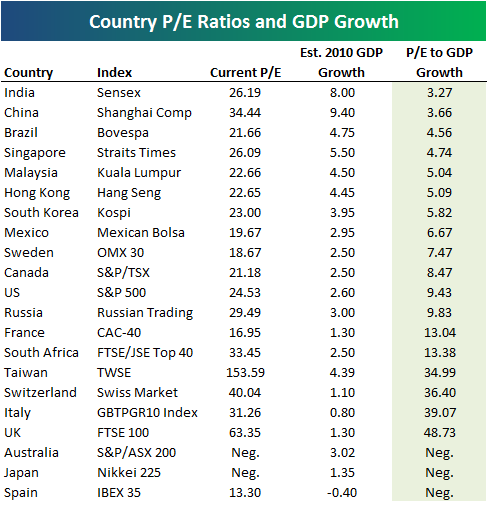
India ranks as the most attractive, followed by China and Brazil. Save for Russia, that's the whole BRIC trump card. Now, what's even more interesting is that Malaysia ranked near the top as well together with Singapore and HK. Foreign funds have been avoiding Malaysia like a plague for the past 18 months, will that trend continue. Many research strategists seem to think foreign funds will continue to underweight Malaysia. I have shifted tack and I think the Malaysian market may actually outperform most Asian bourses for the first half of 2010. The second half is still a bit unclear to make a confident call.


Worries over political stability should be ebbing now that Najib seems to have stood the "uncertain first year" in the office. Many funds were adopting a wait and see attitude with respect to Malaysia as many were thinking that many issues and factors were very "volatile" and fluctuating in the first few months. I think that stage has passed.


Bank Negara has managed very well, not letting the economy dwindle and keeping a lid on pessimism. The catalyst for Malaysia will be the ringgit outlook. I do think Bank Negara will be allowing the ringgit more leeway going forward, and that is a major attraction to funds. Valuation wise, its not demanding. The domestic economy is flushed with liquidity, just go to any new property launches. These are all a potent mix.


p/s photos: Jarah Mariano

Why FBM KLCI Can Touch 1,260 In This Rally


Foreign funds have largely neglected Malaysia for the past 6 months, even though equity markets in general have performed well. Asian equities have outperformed mature markets in 2009 thanks to foreign institutional investment inflows, hopes of economic revival in H2 2009, and fiscal stimulus and liquidity measures that are finding their way into equities. These factors might be making some Asian markets expensive.

Markets have gained 48% YTD as of July 27 (82% since October 2008) with China (50%), India (65%) and Indonesia (62%) as the best performers, and Vietnam (22%) and Malaysia (35%) as the worst. Hence, looking at the broader picture, Malaysian equities have been a huge laggard and under performer. The first chart basically shows how much funds from foreign investors have dried up for Malaysian equities.


That has been reflected in the level of foreign ownership of listed Malaysian shares. Despite the consensus that the global economy may well be on its way to recovery, foreign funds ownership levels has not gotten anywhere back to the pre-crisis level of say April 2008 (25.7%).

I have managed to come across a great chart by the highly respected Bank Credit Analyst, which basically explains which markets would "see the most action" in this current rally. Anyone could plot a valuation chart based on the country's prevailing interest rates and match that with the country stocks' forward or trailing PER. That would be quite one dimensional. The BCA's chart is a lot more persuasive in that it is based on forward and de-trended (I don't even want to attempt to know what that word meant, but it sounded so sophisticated) trailing PERs, price to book ratio, and dividend yields shown relative to the average of 18 countries".

Hence it is a peer-to-peer analysis. There is one major shortcoming in that tabulation, in that it does not take into account the historical average valuation of each specific market say over the past 5 years. The BCA chart only looks at how each country is faring in valuation terms relative to one another. For example, if Malaysia's historical PER forward valuation was 18x, and HK's historical PER forward valuation figure is 15x - naturally if we just look at PER, HK will always look cheap relative to Malaysia. However if the current forward PER for Malaysia and HK are 14x and 13x respectively - HK would still be cheaper on a straight out valuation but in actual fact, we should look at its PER now compared to the historical valuation for a more nuanced and value-add commentary, whereby Malaysia's market would be the 'cheaper' one.

Malaysia - You wouldn't get many houses recommending Malaysia, but the BCA thesis puts Malaysia as highly attractive. Bank Negara's recent decision to leave rates unchanged makes things hotter still till the next BN meeting.

What has been happening over the past week or so - I am beginning to see a trickling of fund flowing back into Malaysia. The first two charts basically imply that we are at a low and foreign holdings and funds inflow can only turn positive from here on. The lack of foreign funds inflow for the past 6 months can be largely attributed to the uncertain political environment - the situation is much better now despite rumblings here and there.

When we least expect it, we are likely to see 1,260 being hit at least in this run alone on momentum - just look at the top volume stocks and top gainers today.
Copyright © Long Term Payday Loans. All Rights Reserved.
Blogger Template designed by Click Bank Engine.