Showing posts with label angelababy. Show all posts

My #1 Black Swan In 2010


While the whole black swan thing sounds interesting, how are we to make a conscious effort to incorporate it into our analysis? Let's look again at Taleb's thesis:
... the existence and occurrence of high-impact, hard-to-predict, and rare events that are beyond the realm of normal expectations. Taleb regards almost all major scientific discoveries, historical events, and artistic accomplishments as "black swans"—undirected and unpredicted. He gives the rise of the Internet, the personal computer, World War 1, and the September 11 2001 attacks as examples of Black Swan Events. To a large extent, the subprime crisis is another prime example of a Black Swan.

"What we call here a Black Swan (and capitalize it) is an event with the following three attributes. First, it is an outlier, as it lies outside the realm of regular expectations, because nothing in the past can convincingly point to its possibility. Second, it carries an extreme impact. Third, in spite of its outlier status, human nature makes us concoct explanations for its occurrence after the fact, making it explainable and predictable. I stop and summarize the triplet: rarity, extreme impact, and retrospective (though not prospective) predictability. A small number of Black Swans explain almost everything in our world, from the success of ideas and religions, to the dynamics of historical events, to elements of our own personal lives."

Taleb contends that banks and trading firms are very vulnerable to hazardous Black Swan Events and are exposed to losses beyond that predicted by their defective models.

Taleb's Ten Principles for a Black Swan Robust World

Taleb enumerates ten principles for building systems that are robust to Black Swan Events (my comments in brackets):

  1. What is fragile should break early while it is still small. Nothing should ever become too big to fail. (We cannot allow financial firms to get so big that they cannot be allowed to collapse on its own. We cannot allow a domino effect owing to firms getting too big. Big financial firms need to be broken down into smaller units. In that respect, Obama is taking a leaf from Taleb's book by trying to reform some of the banking practices - consumer banking to be separated from investment banking. IBs to have a strict guideline on leverage to be used for proprietary trading and deal management.)
  2. No socialisation of losses and privatisation of gain. (US banks, insurance firms and automakers are prime examples of this. Malaysia and many other nations have been guilty of this as well. If companies were badly managed, they should be allowed to fail.)
  3. People who were driving a school bus blindfolded (and crashed it) should never be given a new bus. (The funny part was Taleb putting in the phrase "and crashed it", because if a person drove a bus blindfolded and did not crash it, that person must have very special abilities and hence can be trusted to further drive buses. This rule of thumb points to decision makers who have acted recklessly, e.g. CEOs of many mortgage companies; the rating agencies; even Greenspan ... to be never considered for a similar position. In Malaysia, so many CEOs have proven themselves to be inept, thankfully most were not reckless, but still we need to be more vigilant to engage suitable performers and not to always give greenhorns a go at the top job without a good track record managing smaller units.)
  4. Do not let someone making an "incentive" bonus manage a nuclear plant – or your financial risks. (This one is key. We always give incentivised bonuses to managers based on profits or ROE. Take the investment bankers, their bonuses are linked directly to profits generated, and not accounting for the amount of risk and/or leverage deployed. I give you an even better example, which financial firm in the US had the best ROE in 2007 .... you'd never guess it, its Lehman Brothers. We have to rethink how we reward employees, not just in profits generated but also on "safety measures" i.e. no time bombs being created - hence we should include a hefty penalty on cost of capital and leverage deployed on profits generated, plus I would want bonuses tied more closely to "net margins improvements" and staff turnover ratio.)
  5. Counter-balance complexity with simplicity.
  6. Do not give children sticks of dynamite, even if they come with a warning. (Many local councils, even government bodies have been left holding lots of derivative contracts which puts their firms at a very high risk, without a proper assessment of the gravity of the exposure. Even firms like Citic got trashed. More regulations should be put in place on the kind of contracts companies can enter into, maybe some firms should never be allowed to even enter into any new fangled instruments unless board approval has been obtained. Accounting rules should have more detailed reporting standards enforced on all companies who have entered into these derivative contracts, so that investors can better assessed the risks.)
  7. Only Ponzi schemes should depend on confidence. Governments should never need to "restore confidence". (This one, I do not agree with Taleb. When consumer confidence is dented to a pulp, we need to have the "spender of last resort" come in to keep the velocity of money going. Confidence is a huge thing, the lack of it translate to risk-aversion. Governments and regulating bodies are not there to always maintain a bullish market, but they are there to ensure that things do not get whacked to both extremes of the pendulum. You have to restore confidence when things got so hairy following the subprime crisis, if not, the social cost could be too enormous to recover from.)
  8. Do not give an addict more drugs if he has withdrawal pains. (Taleb must be quite against the amount of bailout funding given to firms. I do agree certain firms have gotten too big to fail but there were many that should be allowed to fail.)
  9. Citizens should not depend on financial assets or fallible "expert" advice for their retirement.
  10. Make an omelette with the broken eggs.
So, what's my #1 Black Swan so far for 2010? I have a few, but I will share with you the one on the top of my list. Japanese yen may go in for a huge devaluation in 2010. During the risk aversion period, many people flocked to the yen currency. Seriously, for an economy still grappling with the excesses of the late 80s and early 90s, and going into a deflationary mode, you don't need a strong currency.

Why is this a black swan? Most people assume that Japan should not have a strong currency. Its zero interest rate policy has not been working but most will assume that it may go back from 90 to 100 at the most vis-a-vis the USD. The biggest catalyst has to be the mega government deficit that Japan has. Japan being Japan is doing tai-chi on that issue. The tons of fiscal stimulus pumping over the last few years have not budge the economy. The budget deficit is unsustainable.

S&P: The outlook on Japan was revised to negative on diminishing economic policy flexibility, and ratings were affirmed at AA/A-1+. At a forecasted 100% of GDP at fiscal year end March 31, 2010, Japan’s net general government debt burden is among the highest for rated sovereigns. The ratio of gross government financial debt to GDP is already around 170% on a general government basis (i.e. central and local government and social security funds) and is the highest by far among developed countries (OECD average was 75% in 2007). Moreover, the policies of the new Democratic Party of Japan (DPJ) government point to a slower pace of fiscal consolidation than previously expected. Combined with other social policies that are not likely to raise medium-term trend growth and with persistent deflationary pressures, Japan’s net general government debt-to-GDP ratio may peak at 115% of GDP over the next several years.

Many think that the yen carry trade is done by big hedge funds, but there are a substantial number of Japanese individuals who have borrowed in yen to invest overseas. A weaker yen will reverse that trend.

The key here is many think Japan's fiscal deterioration is a given but also note that Japan has a AA long term rating. A catalyst could come from a few rating agencies downgrading Japan, or Bank of Japan engineering (or allowing) the yen to fall. A major catalyst should be if/when they decide to make a landmark decision on how to tackle their outstanding debt. Its a time bomb because the yen's un-natural strength is largely due to the subprime mess but is dragging Japan into a recession if its allowed to continue. The shock could be exogenous (e.g., a rating agency putting a major AAA-rated country on negative watch) or endogenous (e.g., failure to match supply and demand on a major sovereign issuance). These fears actually emerged on several occasions in 2009, but were not amplified by massive sell-offs as occurred in 1994, despite far higher volatility this time around. The actual catalyst may not even have to come in a downgrade of Japan's ratings, it could be triggered by a major downgrade of another country's sovereign rating.

http://www.asianpopcorn.com/battle_images/Angelababy_22112009102851.jpg

In 2009, downgrades and debt auction failures in countries like the UK, Greece, Ireland and Spain were reminders that advanced economies are not immune to being reprimanded for "poor fiscal fundamentals This year, the "pervasive negative big issues" should be: a weak economic recovery and an aging population, translating to a focus on the increase of the debt burden of many advanced economies, including the U.S., UK, Japan and several eurozone countries.


The weaker yen should happen because Japan does not have foreign currency debt, and the "devaluation" would not hinder their debt absolute value. Key implication of all estimates of Japan's debt is that without increasing the national tax burden (i.e., tax and social security costs)—which is relatively low compared to other major countries—it is impossible to sustain public finances. Unfortunately, raising taxes would curb already weak domestic demand.

Wafer-thin interest rates make it cheap to issue bonds, but the Japanese have decreasing incentive to invest in Japanese government bonds. If Japan must start selling more debt to the foreign market, interest rates may rise to attract any investors. If the market demands an interest rate of anything more than 3.5% then Japan will not have the [tax] revenue to service its debt. Even without a weak economy, Japan's debt numbers are set to get worse because of its aging population and underfunded public pension fund.

Not all black swans are negative events, and in this case, I think the yen can go back to 120 level, literally overnight. When that happens, we will have a chain reaction:
- Japanese stock markets will boom as exporters benefit immediately and companies can be a lot more competitive
- A sharp rise in FDI both short and long term into all types of Japanese assets
- Many Japanese exporters have come to terms with the strong yen over the last 10 years by expanding overseas. The net effect of this yen weakness will reverse the trend and cause more Japanese companies to reinvest in Japanese operations and manufacturing
- BOJ will start to raise interest rates, which will be a good thing really all around
- Exporters in same competitive categories in other countries could see a temporary sell down in their shares


p/s photos: Angelababy

Roubini's New Stance (I Mean Asserting His Old Stance)


This may have been a week old but now I am getting around to it. I didn't post/comment on it because Roubini said the same things. This time, he is sticking to his usual views but using it to reflect on the current stock market rally, saying that stocks have run ahead of fundamentals. My comments in colour.

Bloomberg: New York University Professor Nouriel Roubini, who accurately predicted the financial crisis, said stock and commodity markets may drop in coming months as the gradual pace of the economic recovery disappoints investors.

“Markets have gone up too much, too soon, too fast,” Roubini said in an interview in Istanbul yesterday. “I see the risk of a correction, especially when the markets now realize that the recovery is not rapid and V-shaped, but more like U- shaped. That might be in the fourth quarter or the first quarter of next year.”

Stocks have surged around the world in the past six months as evidence mounts that the economy is emerging from its deepest recession since the 1930s. The S&P 500 has soared 51 percent from a 12-year low in March while Europe’s Dow Jones Stoxx 600 is up 48 percent. The euphoria contrasts with the cautious tone of Group of Seven policy makers, who said after their meeting in Istanbul yesterday that prospects for growth “remain fragile.”

“The real economy is barely recovering while markets are going this way,” Roubini said. If growth doesn’t rebound rapidly, “eventually markets are going to flatten out and correct to valuations that are justified. I see a growing gap between what markets are doing and the weaker real economic activities.”

‘Anemic’ Recovery

IMF predicts the global economy will expand 3.1 percent in 2010, led by growth in Asia, after a 1.1 percent contraction this year. That is still “anemic” and “very weak,” Roubini said.

U.S. stocks fell last week after manufacturing expanded less than anticipated and unemployment climbed to a 26-year high, fueling concern the economy is rebounding more slowly than forecast.

Gains in the S&P 500 have pushed valuations in the index to more than 19 times reported operating profits from the past year, data compiled by Bloomberg show. That’s near the most expensive level since 2004.

The performance of the U.S. economy is probably more sluggish than reflected in stock markets, risking a correction in equities, Nobel Prize-winning economist Michael Spence said last month. U.S. stock-market investors have “over processed” the stabilization of growth in the world’s largest economy, Spence said.

Creating Bubbles

The global equity rally has added about $20.1 trillion to the value of stocks worldwide since this year’s low on March 9. Governments have poured about $2 trillion of stimulus into the global economy while central banks have cut interest rates to close to zero in efforts to revive growth.

“In the short run we need monetary and fiscal stimulus to avoid another tipping point and to avoid deflation, but now this easy money has already started to create asset bubbles in equities, commodities, credit and emerging markets,” Roubini said. “For the sake of achieving growth stability again and avoiding deflation, we may be planting the seeds of the next cycle of financial instability.”

Comments: Yes, there is a gap between the stock market valuations and the real economy. Is the gap justified, its debatable, I think it is. To have a second dip in 4Q 2009 or 1Q 2010 would require probably another big bank to need a bailout or risk failing - Citigroup??... probably not likely. To have a second dip, we might have to see some major central banks tightening too soon... again that is not likely. Central banks are more concerned about jobs and corporate spending, and as long as these two factors do not show significant improvements, we are not going to see any rate hikes. So far only the robust Australian economy have started to hike rates. Norway might follow suit but not the rest.

In fact the longer it takes jobs and corporate spending to recover, the better it is for stock markets - its silly but true. That means low interest rates will prevail, thus forcing funds flow into equities. Yes, it is more likely that we will see an expensive equity markets situation globally over the next two quarters rather than a second major dip like Roubini predicted. Yes, I agree this will be the second bubble in the making if left unchecked, but I see things coming to a head only mid-2010, and even then we have to see how the employment improvement scene is like.

The other point for my views is the willingness of corporations to tap funds to do M&A. This is brought on with a corresponding downturn in risk aversion. Too many companies have been sitting around (on piles of cash) not doing anything for the past 10 months. We have seen a trickling of major M&A activity over the past two weeks and that should pick up steam. Each time a major M&A deal happens, it energises that sector and subsequently the overall market as well.

p/s photo: Angelababy Yang Wing

Why Baltic Dry Index Is So Important & Where Is It Headed


The BDI is a daily survey of demand for shipping of dry goods, which is everything not a liquid (e.g. crude oil primarily), shipped in bulk. All container traffic are measured by an alternate index called HARP. But building materials such as timber or scrap steel, are considered "dry goods" and are a good indicator of economic activity. So, when demand is high for a given supply of ships, the price soars.

This has proven a very good leading indicator for the economy which will show the effect of those material inputs a few months hence. But when demand turns soft and there is less need for shipping to move bulk products around the world, the price drops. Price is very inelastic in respect to demand and the supply of ships takes time to alter. So, for a given short range of time, less than one year, it is hard to find a better indicator of near future economic activity and resultant equity market prices.

The BDI is a daily average of prices to ship raw materials. It represents the cost paid by an end customer to have a shipping company transport raw materials across seas on the Baltic Exchange, the global marketplace for brokering shipping contracts. The index is quoted every working day at 1300 London time. The Baltic canvasses brokers around the world and asks how much it would cost to book various cargoes of raw materials on various routes (e.g. 100,000 tons of iron ore from San Francisco to Hong Kong, or 1,000,000 metric tons of rice from Bangkok to Tokyo).

The index is made up of an average of the Baltic Supramax, Panamax, and Capesize indices. These indices are based on professional assessments made by a panel of international shipbroking companies.

BDvsS&P500

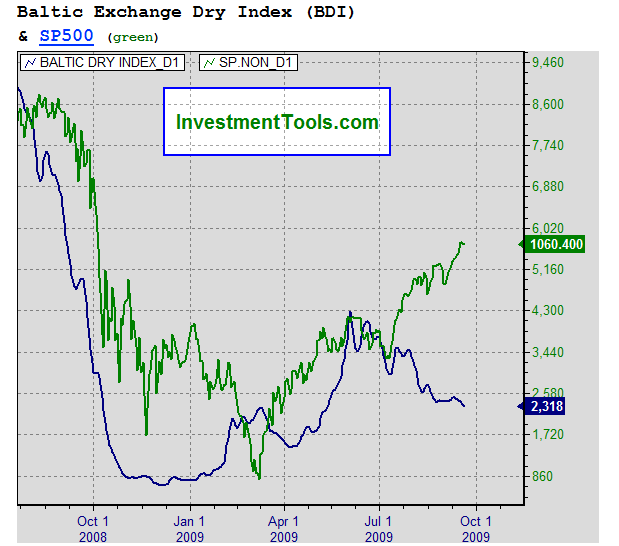
In recent weeks the BDI has staged a substantial correction, leading many confounded as to why things are so. Many believed that the global recovery has started, and that things will still take some time before it gets anywhere to business as usual - even so, the sharp correction in the BDI has some worried. More significantly, those stock markets riding on China leading them out of a recession, may be sitting nervously now - if the mega China stimulus plan is supposed to do what it does, China should be doing a lot of importing, thus the BDI should be well supported, not declining.

The chart above is very telling. Many mid-term traders uses the BDI as a major indicator of whether to hold a lot of positions in the stock market or to pare down their holdings. The correlation with the S&P500 has been uncanny but the thing started to diverge since July 2009. That caused a lot of experts to call for a temporary sell on the equity side, and have been kept getting things wrong. When such a divergence happens, and when you plot one variable against the stock market index... 9 out of 10 times, the experts will say that the stock market index is WRONG and the other variable is right. This blatant discrimination lies in the fact that all experts think that the stock markets are generally made up of idiots, momentum traders, retail players who will buy and sell at the wrong time. The same group of experts will accord "more respect" to BDI because its a more localised index and is research and accumulated from real industry players.

So, who is right? Has the stock markets run ahead of themselves? Even if you look at commodity prices in general, they have held up pretty well over the last 2 months, which is even more confounding - if commodity prices are steady with a slight upside bias, why then was the BDI so weak.

This time around, I am siding with the stock index, I think it is more correct than the BDI. The BDI is a highly volatile indicator, and if you look at it, the BDI has risen enormously for the first half of the year. A correction is normal as many industry operators are loathed to bet on a strong recovery in global trade, they'd rather sell their open capacity as and when possible. The divergence is significant because the BDI has fallen more than 40% since June 09, while the S&P500 has gone the other way.

Traders and experts harping on the sanctity and importance of BDI need to go wash their faces every now and then. Just because the BDI was a good indicator does not mean it will always be a good leading indicator for the stock market. Things evolve. The BDI this time around was very much affected by things happening in China, when they announce the stimulus plan, the BDI went ballistic. When China construction slowed over the last 2 months, the BDI started to collapse. The key is understanding what, where and why China is doing what it is showing. You cannot comment on the BDI superficially until you understand the motivations behind those figures.

The highest level the BDI reached this year was 4,291 points on June 3. The index as of yesterday was just 2,357. The BDI may hit 4,000 points before the year is over just be assessing the increasing demand for iron ore and grains from China. Iron ore demand is linked to construction activity, which many international traders saw as weakening over the last 3 months. One has to understand the nature of construction in China. Most construction works were slow in the third quarter owing to hot weather, which is quite common especially in southern China. The recent cold spell should prompt more coal to be exported to China as well. Iron ore is the largest dry-bulk cargo moved by sea and China is a major consumer of the commodity.

Furthermore bumper crop harvesting such as wheat and corn in the United States would also contribute to the rise in the BDI in the coming weeks. Bloomberg reported China Ocean Shipping (Group) Co as saying the BDI might surge more than 80% by the year-end on increased demand from China.

Aside from the China demand factor, the shipping industry is facing a crucial issue and that is the potential supply of new ships. It is a complicated issue because older ships to transport coal, iron ore, fertilizer and the like are being retired while new ones are coming to take their place. There seems to be more supply than needed coming online over the next 6 months and that's also scaring the BDI lower.

The stimulus plan by China has barely started to kick in but the BDI has staged a magnificent rally since February this year, safe to say here that the BDI has run a bit ahead of the real economy. China has started to turn the taps from its stimulus plan but certainly not all will done in one shot or over just one year, in that sense the BDI may have no reason to join in the rally in the first place with the S&P500, and now is just correcting to the real economy, and not the other way around.


p/s photos: Angelababy Yang Wing


Baltic Dry's Worst Week Since October 2008


The Baltic Dry Index, which tracks shipping costs and is viewed as leading indicator for commodity prices, has had its worst week since the peak of the financial crisis last October, as Chinese demand slowed. The index fell from 3,350 to 2,772 this week – a fall of 17.2pc - as imports of iron ore and coal slowed down. The index is now 35pc lower than its 2009 high, hit on June 3.

Earlier this week Ian Ashby, head of iron ore at miner BHP Billiton, said at the Diggers & Dealers conference in Australia that Chinese restocking of iron ore was at an end. Mr Ashby said that supplies at the country's ports were enough to sustain a month of consumption. However, some believe that imports have slowed down as Chinese steel mills are still locked in talks over the pricing of iron ore imports over the next 12 months. The talks have proved fractious, with the Chinese seeking steeper cuts in pricing than the 33pc agreed with steel mills in Korea and Japan. Chinese authorities also arrested four members of Rio Tinto's iron ore team, accusing them of stealing state secrets and bribery.


According to Bloomberg, the index slid 4.6% or 135 points bringing the average to 2,772 which brings this week total loss of the index to 17%. This might also explain to some length as to why the USD has rallied over the last few days - as smart money positioned itself for weaker equity markets. Hence brace yourself for some sustained sell down in the US markets especially in coming days. Although markets will be volatile with a downward bias over the next few days, I still think the underlying bull run is intact, buy on dips.


p/s photos: Angelababy Yang Wing

VIX Made A New Short Term Low


One of the big measures of risks is the VIX indicator. As we can see from the chart from Bespoke, the down trending VIX correlates inversely with the S&P 500, not 1 to 1 but close enough to be interesting. This lends weight to another factor girding the underlying bull run.

While one measure of volatility recently made a new short-term low, the VIX volatility index recently failed to take out its recent lows and is now trading back above 30 even when the overall market has made new short-term highs. This failure to head lower has some investors looking for a pause in the rally, as fear of a pullback seems to be creeping back into the market.

Spxvix603


p/s photo: Angelababy Yang Wing
Copyright © Long Term Payday Loans. All Rights Reserved.
Blogger Template designed by Click Bank Engine.