Showing posts with label China economy. Show all posts

China Is Aware That There Is A Bubble


As China is facing the prospect of large capital inflows from investors betting on RMB appreciation in 2010, policymakers have made it easier for mainland Chinese to invest abroad. This may be adding to the massive fund inflows other regional markets have experienced in 2009, especially China’s SARs. China’s rapid credit growth and loose monetary policies are also encouraging the trend.

  • WSJ: A bubbly property market in Hong Kong and record gambling revenues in Macau are partially a result of capital leaking out of China through “under-the-table transfers.” GaveKal Dragonomics says that the scale of the “shady money” coming from China’s loose credit and stimulus measures “is becoming slightly embarrassing for Beijing.” Capital controls are supposed to regulate the amount of money flowing to the SARs, but offshore bank accounts and other channels allow money to flow relatively freely. (11/23/09)
  • Michael Casey, WSJ: “[A] booming China is importing easy money from the Fed at a time when it least needs it, and is then exporting the same to its similarly undeserving neighbors.” (11/18/09)

Measures Taken to Increase Capital Outflows

  • On November 11, the State Administration of Foreign Exchange (SAFE) said it would expand a program that allows individuals to exchange up US$5,000 per-day to non-financial institutions. This helped to spark a rally in China’s B-shares, which are mainland shares denominated in foreign currencies. (Bloomberg, 11/13/09)
  • In October SAFE announced US$1.5 billion in new quotas under the qualified domestic institutional investors (QDII) program, which allows mainland funds to be invested in overseas assets. These were the first new quotas granted in 17 months.
  • In July 2009, SAFE eased rules on the use of foreign exchange by Chinese firms, which will allow companies to borrow in foreign currencies on the mainland, invest with their foreign exchange revenues, and seek new funding sources.
  • China's outbound direct investment reached US$55.6 billion in 2008, nearly double the amount in 2007, but much lower than the US$92.4 billion of inbound direct investment. In 2009, the gap looks may narrow. Through Q3 2009, the Ministry of Finance reported US$32.8 billion in non-financial outbound FDI, up slightly from the same period last year. Meanwhile, FDI to China decreased 14% y/y over the same period.
  • Mainland Chinese are limited to converting US$50,000 per-year into foreign currency, but investors often pool the quotas of family and friends to get around the limits.

p/s photo: Maggie Wu

How Sustainable Is China's Growth


  • China's economy expanded 8.9% y/y in Q3 2009, bringing the year-to-date growth rate up to 7.7% y/y. Industrial production (value added) expanded 12.4% y/y in Q3, up from 9.1% in Q2. Investment continues to drive growth with fixed asset investment grew by 33.4% through Q3, 6.4 percentage points above the rate posted the year previous. Consumption has held up, with retail sales climbing 15.1% through Q3 in nominal terms, or 17% in real terms. CPI fell 1.1% through Q3 but has climbed on a monthly basis. Exports and imports are likewise climbing on a m/m basis. (National Bureau of Statistics, 10/21/09)
  • The Outlook for Q4 and Beyond

  • The pace of growth slowed in Q3 to about 9.5% on an annualized q/q basis in Q3 from an estimated 16% pace in Q2. Industrial production growth picked up to 13.8% in September from 12.8% in August and 10.8% in July. Retail sales accelerated slightly to 15.5% y/y, roughly similar to August's 15.4% growth and consumer prices have continued to climb on a m/m basis falling only 0.8% y/y in September (from -1.2% in August).
  • Premier Wen Jiabao: "China’s economic rebound is unstable, unbalanced and not yet solid. We cannot and will not change the direction of our policies when the conditions aren’t appropriate.” (via FT, September 2009)
  • Minggao Shen and Ken Peng of Citi note that "domestic demand is still the main driver of current economic momentum in China. Retail sales are again accelerating after holding steady in the spring.The 15.4% y/y growth received large support from the housing boom, as construction materials sales grew 36.6%y/y, up from 25.8% in July" while other goods were merely stable. However, a pickup in exports (they fell on an absolute and seasonally adjusted basis from July) is needed for further growth momentum as other stimulus may have already peaked (09/ 11/09)
  • Economist Lu Ting, Bank of America-Merrill Lynch: Growth could reach 9% in Q3 and 10% in Q4. (via Bloomberg)
  • Flemming Nielsen of Danske Bank forecasts that "sequential growth in industrial production in China is slowing, despite the year-on-year growth in industrial production in August to around 13.0% y/y from 10.8% y/y in th previous month. This development will be consistent with GDP growth easing to around12% q/q in Q3 from more than 16% q/q in Q2. " (09/07/09)
  • Q2's reacceleration

  • Chinese growth accelerated to 7.9% y/y in Q2 2009, from 6.1% in Q1 (the slowest in more than a decade) as Chinese investment and bank lending continued to accelerate, and retail sales held up. Government spending and bank lending have contributed to faster growth despite weak exports. Q2's growth which analysts suggest was 12=16% on a q/q basis came was the first acceleration after seven quarters of deceleration. Investment (35.3%) and industrial production (10.7%) saw further increases on a y/y basis in June 2009, while construction rose for the first time in a year.
  • Economist Ken Peng, Citi: The annualized q/q pace of growth was around 11.8% from Q2, but the weakness in consumer prices indicates China is not out of the woods.
  • National Bureau of Statistics: Of the 7.1% real GDP growth in H1 2009, 6.2 percentage points (ppts) came from investment, spending contributed 3.8ppts and net exports took away 2.9ppts. (via Citi)
  • How Sustainable Is China's Recovery?

  • IMF: Expansionary fiscal/monetary policies, a rebound in capital markets/inflows, and the growth impulse from restocking helped China's economy to recover. The IMF forecasts 8.5% real GDP growth in 2009 and 9% growth in 2010. "With the recovery gaining strength, the policy challenge is to determine when and how to withdraw policy support while ensuring a successful transition to more balanced medium-term growth."
    (October 1, 2009)
  • World Bank: Very expansionary fiscal and monetary policies kept the economy growing respectably with a 7.2% growth rate is expected for 2009. China may not grow in the high double digits until the global economy recovers. Market-based investment will lag, and consumption will slow, meaning that the boost to growth may not carry through to 2010. (June 2009)
  • OECD: Because of China's policy responses, Chinese GDP growth is forecast to be 7.7% in 2009 and 9.3% in 2010, an upward revision from March forecasts of 6.3% in 2009 and 8.5% in 2010. (June 2009)
  • Morgan Stanley: "On a seasonally adjusted basis, the economy experienced a 5% rebound in Q1 2009, after the first q/q contraction (-0.5%) in almost eight years. Aggressive policy stimulus should bring further recovery in H2 2009, making China among the first to emerge from the global downturn. The recovery should be relatively 'job-rich' but 'profit-deficient,' especially in H1 2009, with those exposed to government-supported capex programs likely benefiting most."
  • Bank of Finland: "The massive increase in lending associated with the stimulus package could lead to imbalances in the Chinese economy, which might make economic policy more difficult and constrain growth. The current stimulus measures have only reinforced the investment- and export-orientation of the economy, while domestic demand continues to play a minor role." (September 2009)
  • ADB suggests China is not rebalancing away from investment-led growth, but is shifting investment sectors. China runs the risk of entrenched inflation and overheating in some sectors.
  • In Q1, government stimulus boosted investment and consumption held up, despite a fall in real incomes. Final consumption, investment and net exports contributed 4.3, 2.0 and -0.2 percentage points to GDP, respectively.


p/s photos: Kim Ahep

HK's Economy Turning A Corner, China's Chugging Along


Twin rays of hope flickered through the economic gloom yesterday: Hong Kong's jobless rate has fallen for the first time in 13 months and pay levels are on the rise.

The number of unemployed during the July-September period fell by 7,700 - from 216,800 in June-August to 209,100. That means an unemployment figure of 5.3 percent against the previous 5.4 percent, which is modest at best.

But economists are cheered by the data. They see more falls in jobless figures unless there is another reverse in the wake of last year's crash. The good news about pay came after a Baptist University survey between July and September featuring 104 companies and covering 66,000 employees.

High on the list of key findings is the indication that people are likely to receive pay rises of 1.2 to 1.3 percent in the coming year. That is only a slight improvement on last year, when rises rounded out at 0.4-0.7 percent, but again it is seen as a turn for the better.

In 49 companies, researchers found, 3,000 employees were made redundant. But firms added 5,035 new posts, with the construction sector accounting for 38 percent of them. The figures were in tune with government data on employment, pointing to better job prospects in construction, information and telecommunications, arts and recreational and leisure services in particular. The jobless rate for the construction sector, which has been among the most troubled in recent times, dropped 0.7 percentage points to 9.4 percent.

Bank of East Asia chief economist Paul Tang Sai-on said an improvement in the trading sector is expected to support the labor market for the next three to six months at least. "Slower declines in trading volumes over recent months show that the core industry in Hong Kong is recovering."

Secretary for Labour and Welfare Matthew Cheung Kin-chung preached caution, however, pointing out that the recovery path may still be bumpy as the global economy remains unstable. "The government will remain vigilant."

Still, government officials say efforts to boost youth employment have begun to take effect, pointing to the jobless rate of 15- to 19-year-olds dropping by 2.7 percentage points to 25.7 percent.

Hang Seng Bank senior economist Irina Fan Yuen-yee attributes the employment improvement to a shrinking labor force - it decreased by around 7,400 during the three-month period - and the government's spending stimulus and subsidy programs for graduates.

Citi economist Cheng-Mount Cheng said: "We expect the jobless rate to remain elevated in the coming months when the labor force resumes expansion, but jobs are likely to become more plentiful."

China's economy expanded more than 7 percent in the first nine months, making Beijing's full-year target of 8 percent growth more achievable, according to the state planning agency.

Three days before official figures are released, Xiong Bilin, a senior official of the National Development and Reform Commission, said the mainland's gross domestic product for the first three quarters was around 7.1 percent. This was lower than a Reuters poll showing the average forecast was 8.9 percent.

CCB International said China's third- quarter growth would be about 8.9 percent, while consumer prices fell marginally by 0.8 percent from a year ago. But the investment bank expects inflation to rise 0.3 percent in September from August, reflecting a steady growth momentum. Fixed direct investment in September also rose, soaring 33.2 percent year on year and higher than the 22 percent in August, CCBI said.

In a bid to curb potential asset bubbles caused by overspending under Beijing's stimulus plans and ensure steady economic growth, the NDRC and nine industry department heads will try to prevent overcapacity in six sectors. They will do this by withholding approval for any new investment that does not follow procedures and is not in line with government policies.

The sectors are steel, cement, plate glass, coal chemicals, polysilicon and windpower equipment.


p/s photo: Yasuda Misako

Why Baltic Dry Index Is So Important & Where Is It Headed


The BDI is a daily survey of demand for shipping of dry goods, which is everything not a liquid (e.g. crude oil primarily), shipped in bulk. All container traffic are measured by an alternate index called HARP. But building materials such as timber or scrap steel, are considered "dry goods" and are a good indicator of economic activity. So, when demand is high for a given supply of ships, the price soars.

This has proven a very good leading indicator for the economy which will show the effect of those material inputs a few months hence. But when demand turns soft and there is less need for shipping to move bulk products around the world, the price drops. Price is very inelastic in respect to demand and the supply of ships takes time to alter. So, for a given short range of time, less than one year, it is hard to find a better indicator of near future economic activity and resultant equity market prices.

The BDI is a daily average of prices to ship raw materials. It represents the cost paid by an end customer to have a shipping company transport raw materials across seas on the Baltic Exchange, the global marketplace for brokering shipping contracts. The index is quoted every working day at 1300 London time. The Baltic canvasses brokers around the world and asks how much it would cost to book various cargoes of raw materials on various routes (e.g. 100,000 tons of iron ore from San Francisco to Hong Kong, or 1,000,000 metric tons of rice from Bangkok to Tokyo).

The index is made up of an average of the Baltic Supramax, Panamax, and Capesize indices. These indices are based on professional assessments made by a panel of international shipbroking companies.

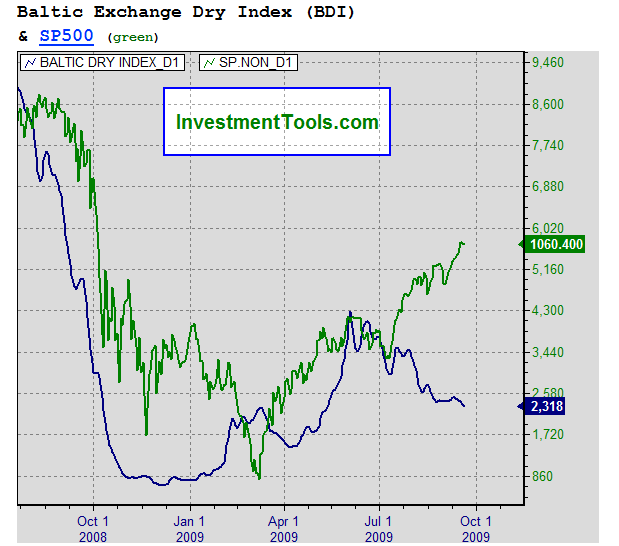
BDvsS&P500

In recent weeks the BDI has staged a substantial correction, leading many confounded as to why things are so. Many believed that the global recovery has started, and that things will still take some time before it gets anywhere to business as usual - even so, the sharp correction in the BDI has some worried. More significantly, those stock markets riding on China leading them out of a recession, may be sitting nervously now - if the mega China stimulus plan is supposed to do what it does, China should be doing a lot of importing, thus the BDI should be well supported, not declining.

The chart above is very telling. Many mid-term traders uses the BDI as a major indicator of whether to hold a lot of positions in the stock market or to pare down their holdings. The correlation with the S&P500 has been uncanny but the thing started to diverge since July 2009. That caused a lot of experts to call for a temporary sell on the equity side, and have been kept getting things wrong. When such a divergence happens, and when you plot one variable against the stock market index... 9 out of 10 times, the experts will say that the stock market index is WRONG and the other variable is right. This blatant discrimination lies in the fact that all experts think that the stock markets are generally made up of idiots, momentum traders, retail players who will buy and sell at the wrong time. The same group of experts will accord "more respect" to BDI because its a more localised index and is research and accumulated from real industry players.

So, who is right? Has the stock markets run ahead of themselves? Even if you look at commodity prices in general, they have held up pretty well over the last 2 months, which is even more confounding - if commodity prices are steady with a slight upside bias, why then was the BDI so weak.

This time around, I am siding with the stock index, I think it is more correct than the BDI. The BDI is a highly volatile indicator, and if you look at it, the BDI has risen enormously for the first half of the year. A correction is normal as many industry operators are loathed to bet on a strong recovery in global trade, they'd rather sell their open capacity as and when possible. The divergence is significant because the BDI has fallen more than 40% since June 09, while the S&P500 has gone the other way.

Traders and experts harping on the sanctity and importance of BDI need to go wash their faces every now and then. Just because the BDI was a good indicator does not mean it will always be a good leading indicator for the stock market. Things evolve. The BDI this time around was very much affected by things happening in China, when they announce the stimulus plan, the BDI went ballistic. When China construction slowed over the last 2 months, the BDI started to collapse. The key is understanding what, where and why China is doing what it is showing. You cannot comment on the BDI superficially until you understand the motivations behind those figures.

The highest level the BDI reached this year was 4,291 points on June 3. The index as of yesterday was just 2,357. The BDI may hit 4,000 points before the year is over just be assessing the increasing demand for iron ore and grains from China. Iron ore demand is linked to construction activity, which many international traders saw as weakening over the last 3 months. One has to understand the nature of construction in China. Most construction works were slow in the third quarter owing to hot weather, which is quite common especially in southern China. The recent cold spell should prompt more coal to be exported to China as well. Iron ore is the largest dry-bulk cargo moved by sea and China is a major consumer of the commodity.

Furthermore bumper crop harvesting such as wheat and corn in the United States would also contribute to the rise in the BDI in the coming weeks. Bloomberg reported China Ocean Shipping (Group) Co as saying the BDI might surge more than 80% by the year-end on increased demand from China.

Aside from the China demand factor, the shipping industry is facing a crucial issue and that is the potential supply of new ships. It is a complicated issue because older ships to transport coal, iron ore, fertilizer and the like are being retired while new ones are coming to take their place. There seems to be more supply than needed coming online over the next 6 months and that's also scaring the BDI lower.

The stimulus plan by China has barely started to kick in but the BDI has staged a magnificent rally since February this year, safe to say here that the BDI has run a bit ahead of the real economy. China has started to turn the taps from its stimulus plan but certainly not all will done in one shot or over just one year, in that sense the BDI may have no reason to join in the rally in the first place with the S&P500, and now is just correcting to the real economy, and not the other way around.


p/s photos: Angelababy Yang Wing


China's Domestic Consumption - Glass Half Full or Half Empty


The following table by McKinsey was highly illuminating. It puts into sparkling perspective how important private domestic consumption is to each country as a percentage of GDP. One should always strive to be more led by domestic consumption as that usually means a better grasp and control of an economy's fortunes. China has been desperately trying to lead the world back from the diminished global trade due to the recent global financial crisis by shifting from an investment led economy to a more domestic driven type. As the table shows, its a long uphill climb still. Thats the negative way of looking at things - the half full view would be that there is still a lot China can do (and will do) to ramp up its domestic economy, and it will only means more consumption of global goods and services in the long run. Its going to be the Asian century mainly by moving just 10%-20% of the rural folks in China and India into the middle class consumption category.

On a side note, Malaysia's domestic consumption as a percentage of GDP is high enough but the major caveat about looking at tables such as these is that if your population is smallish, the high private domestic consumption percentage figure is too one dimensional. If your population is say less that 50m, you probably HAVE to be led by investment as a priority as your population will not be able to generate sufficient critical mass of demand for your industries to compete on a global scale with the economies of scale that is needed.

china-gdp


p/s photos: Jessica Gomes

China's Growth Story Too Dependent On Easy Credit?


Just how dependent is the China growth over the last 6 months on the easy credit conditions? This blog has been harping on the liquidity trap that is almost inevitable. The flip side is that the markets in China and HK will continue to benefit as Beijing would continue to "allow and encourage" more state firms to list in Shanghai and/or do a H-share listing - both very effective ways to drain some of the liquidity from the system, or at least keep it within a sphere where it could be 'controlled' somewhat.

Bank lending surged in H1 2009 to RMB7.37 trillion (US$1.08 trillion), more than three times higher than H1 2008. The figure, totaling 25% of China's annual GDP in 2008, is 47% higher than the government's RMB5 trillion target for 2009. There is significant monthly variation, however. Available data suggests that lending slowed in July 2009 even more than in April and May 2009, but June loans surged to RMB1.53 trillion (US$224 billion), a return to Q1 levels. New loans could surpass the revised RMB10 trillion benchmark for 2009. The scale of loan extension has sparked sustainability concerns, raised the risk of non-performing loans (NPLs) and helped to fuel asset-price inflation (property and equities). However, concerns that the government might rein in loans contributed to a weakening of equity markets in early August.

    Will Lending Growth Continue?

  • Banks lent RMB1.53 trillion (US$224 billion) in June, more than double the RMB664.5 billion extended in May, sparking concerns that tightening may follow. M2 rose 28.5% in June, and outstanding loans were up 34.4% y/y in June (both record highs). The central bank may have already started to tighten, selling more bonds to soak up some of the liquidity.
  • The reported lending figures from China's largest banks suggest that July's new lending should total around RMB400 billion (US$58.6 billion). Many of the commercial bills from earlier in the year will be refinanced in July through September, reducing new lending. Still, credit availability will likely remain relatively loose.
  • The big four banks reportedly cut lending to RMB168 billion (US$24.6 billion) in July from RMB497 billion (US$72.7 billion) in June, though smaller banks have increased their share of lending in recent months from about half to two-thirds. As a result, lending may not have slowed as much as some estimate.
  • If state-owned banks contributed one third of July new bank lending, like they did in Q2, then the July figure should come in around RMB500 billion (US$73.2 billion). Though if the trend of smaller commercial banks contributing a greater share continues, the actual figure could be higher.
  • The narrowing spread between M1 (18.7% y/y in May, up from 17.5% in April) and M2 (25.7% y/y in May, down from 26% in April) suggests that economic growth is gaining momentum as corporations are increasingly confident and willing to embark on future investments.
  • Loan growth shifted toward medium- and long-term loans in Q2. Commercial bills accounted for 21% in April, down from 32% in Q1, while other short-term loans declined by nearly RMB80 billion. Deposits again outpaced loans, reducing the loan-deposit ratio, which should marginally ease fears of bad debts, as firms are storing liquidity.
  • Even if loan growth slows, the net increase in loans might be around RMB8-8.5 trillion, 26-28% above 2008 for loans outstanding.
  • Factors Behind Lending Expansion

  • The People's Bank of China (PBoC) is unlikely to tighten monetary policy because the central bank is not accountable for regulating bank risk. Bank lending is playing an important role in the fiscal stimulus, and the central bank may plan to pump in money to fill holes in banks’ balance sheets from bad loans.
  • The Banking Regulatory Committee is raising minimum capital adequacy requirements from 8% in 2008 to 12% by 2010, but the PBoC controls the reserve requirements, blunting the regulators’ ability to control loan growth.
  • The China Banking Regulatory Commission may rule that subordinated debt held by another bank will no longer qualify as supplementary capital. Estimates suggest that as much as 51% of subordinated debt issued by banks (RMB210.0 billion in H1 2009, three times last year's total level) is held by other banks, which could lead banks to curtail new lending. That would be an easier path to better capital-adequacy ratios than finding buyers for the debt outside of the financial sector.
  • The China Banking Regulatory Commission suggested that a concentration of credit in some industries and businesses may pose a threat to the financial system. Banks should rely more on syndication to share the risks from new lending, the secretary of the commission said.
  • Loan growth is driven by monetary policy that encourages banks to expand loan portfolios. Banks make up for lower loan margins with expanded loan volumes and an assumption that stimulus-related credit losses will be covered by the central and/or local government. The increase in corporate loan portfolios and credit expansion may threaten the medium-term outlook for Chinese banks.
  • Michael Pettis, Peking University: "Tighter monetary policy may be necessary to contain future inflationary pressures, but the unclear economic outlook and political priority of growth make this unlikely."
  • Wu Xiaoling, PBoC Deputy Governor: The government's moral persuasion is declining. Banks should diversify, but not lend excessively in search of sustainable profits.
  • Loan curbs postponed investment in H2 2006, while loans and investment reaccelerated in Q1 2007.
  • Risks from Lending Growth

  • The efficiency of new loans is in doubt, as the economy does not have the capacity to turn these new loans into real activity. Potential tightening policies would further challenge the financing of small and medium sized enterprises.
  • NPLs may not reach 1990s levels, as most of the current round of lending has gone to local-government-backed projects rather than unprofitable state-owned enterprises. Also, because Chinese banks are more dependent on deposits than wholesale markets for funding and China's capital account remains closed, there is little risk of a financial crisis.
  • As much as 20% of the bank loans in the first five months of 2009 (US$170 billion) was invested in the stock market, while another 30% may have been used for discounted bill financing.
  • China's National Audit Office found that six Chinese banks in 2008 had extended more than US$4.39 billion worth of irregular loans, an indication of inadequate management at some of the banks' local branches. The issues included improper land purchases, fraudulent mortgages and loans to non-qualifying property developers and non-approved mortgages.

p/s photos: Meisa Kuroki

China's Rising Reserves, US Fiscal & Current Account Deficits


The following is a summary of a good article by Michael Pettis on whether China's reserves goes to fund the US fiscal deficit:


Mainland China's foreign reserves surged to a record US$2.13 trillion at the end June2009, confirming concerns that speculative capital is flooding into the nation to bet on rising asset prices and a quick economic recovery. Reserves rose US$178 billion in the second quarter, the biggest quarterly increase on record and up from the US$1.95 trillion yuan at the end of March. Most of the increase was driven by the very large trade surplus and smaller but still high net FDI inflows, plus of course returns on the existing portfolio. However, there is the unexplained portion of the increase in reserves, which serves as a proxy for hot money, has turned from negative in the first quarter to
very positive in the second.

Hot money is pro-cyclical, and its effect will be to intensify growth in the short term, even as it increases volatility and makes monetary policy more difficult. China's central bank must recycle the net surplus on the current account and the capital account, and with the very high current account surplus, China would be creating a huge amount of domestic money just from that source. The fact that it is also running a large capital account surplus makes the central bank's monetary management that much more difficult. As long as this fiscal-stimulus-induced boom continues, hot money inflows will heat things up even more.

Does the fact that China has huge reserves mean that they will be buying loads of US Treasuries? Is China still funding the US deficit? Most people will not be differentiating between the
US fiscal deficit and the US current account deficit. China is mainly funding ONE of them, not both of them altogether. When we take things and argue, we must be clear on the details because we end up revealing how shallow and little we know of the subject matter.

Goldman Sachs Group Inc. estimates that US government borrowing may total US$3.25 trillion in the year ending Sept. 30, almost four times the US$892 billion in 2008, to finance the budget deficit. Here is an example of warped thinking and a poor grasp of economics :
“China’s reserves will allow the U.S. to run a higher fiscal deficit than other nations,” said Bilal Hafeez, the London-based global head of currency strategy at Deutsche Bank AG.

That is incorrect and flawed. The fact that China’s reserves have surged will in no way make it easier for the US to fund its fiscal deficit even though China has no choice but to invest these additional reserves in US Treasury bonds. Besides valuation changes and interest income, there are two reasons for the increase in the reserves – the very high trade surplus and net capital inflows into China. Take the second reason first. If money flows into China for investment purposes, it must flow out of somewhere else, and that somewhere else for the most part means the global pool of dollar savings which would anyway have been available to fund the US fiscal deficit directly or indirectly. China is acting like a unique bank that takes risk-seeking money and funnels it into low-risk assets. The USA profits from this intermediation while China runs a significant negative carry.

What about the dollars generated from the trade surplus and invested into US Treasury bonds? Won’t that help the US fund its fiscal deficit? Again the answer is no. The US government is not borrowing for abstract reasons, but rather is borrowing in order to spend locally to generate domestic employment. The amount of borrowing it needs to generate a fixed amount of domestic jobs is correlated with the US trade deficit, because it is through the trade deficit that domestic consumption “leaks out” to create jobs abroad. The higher the trade deficit, in other words, the more the US government needs to borrow to generate a fixed number of American jobs, and so the fact that China is reinvesting the dollars generated by the trade surplus with the US does not make it easier for the US to borrow since it simultaneously requires the US to borrow more. China does not fund the US fiscal deficit. It funds the US current account deficit, and it has no choice but to fund it. If the US wants China to buy US$1 trillion of new bonds every year all it has to do is ensure that the US runs a US$1 trillion trade deficit with China every year.

China may continue to bitch and scream about the Fed's printing press and the plethora of US Treasuries, but they will have to continue to buy and fund the US because the flip side of the coin does no one any good.


p/s photos: Zhou Weitong

China's Lending Explosion


Is there anything wrong with China's lending spree. The central bank basically "advised" banks to ratchet up their lending, and the banks followed dutifully for the past couple of quarters with amazing results.


First of all, you cannot suddenly find so many attractive "borrowers" to lend aggressively to. Secondly, not many will say no when you offer to lend them money.


To be fair, this strategy pulled the domestic economy from falling further along with the ill effects of a global economy in crisis, but at what price. As I have mentioned before, this has to play itself out, and will not result in a sudden correction in property or stock prices in China. The liquidity rush will soon find its way into higher equity prices in China (hence bullish for the rest of the year for Chinese equity), and some may trickle back into Chinese property mart as well. Brace for high default rates when the music stops, probably after Chinese New Year in 2010.


China’s new lending more than doubled in June from a month earlier, increasing concerns bad loans and asset bubbles will emerge amid a credit boom.


New lending was 1.53 trillion yuan ($224 billion), the central bank said on its Web site today, bringing total lending this year to 7.4 trillion yuan. The calculation for new loans is preliminary, the central bank added.


The government is countering an export collapse by flooding the economy with money to fuel domestic demand. Rapid credit growth poses a risk to the nation’s lenders and a concentration of credit in some industries and businesses may damage the stability of the financial system, the banking regulator said yesterday.


Excess liquidity is fueling speculation and that means asset bubbles and wasteful investment. Already China recently failed to complete a $4.1bn auction of one-year government bonds, which suggested that investors are positioning for higher inflation caused by the credit surge.


Just something more to chew on, in 2005 Ernst & Young published a survey estimating that the bad loans in the Chinese banking system equaled close to $900 billion. Since then there has been enormous speculation in both the stock and real estate market. The average urban residential property prices fell by 15 to 30 per cent over the next two years from their levels at the end of 2008. Of course, by the end of 2008 they had already fallen from there 2007 highs. You cannot have real estate fall that much without having bad loans. Here is the juicy part, according to the prospectus for the Commercial Bank of China, it is illegal in China to foreclose on residential property.So what are bad loans? Bad loans = immediate write downs? No, they are then carried as what??? ... long term assets???
The reality is that no one knows exactly how bad the situation is in any bank. Information has value and is not disclosed unless required by law or for consideration. Since the banks in China are owned by the state, there is no legal requirement.


Something's gotta give ... but let's have a bull run first...


p/s photos: Elanne Kong Yuk Lam


China's Liquidity Traps & Benefits


China has been ramping up lending over the last 7 months. Yes, it was with good intentions. Yes, it was actual lending not just for show. Yes, banks in China were "asked" to do their bit to lend aggressively. While there is a lot of good to have money circulating around, it will also weigh down on those borrowing on the "unqualified" end of the spectrum, people who willing take on more debt than they should. Its a mini time bomb. No, it will not implode yet. What the figures below shows to me is that China's equity markets will have a major run up right through the end of 2009. When you pump in so much liquidity, there are very few places for it to surface. We may see a combustion effect only maybe in the second half of 2010.

China's credit card debt that was at least six months overdue rose 133.1 percent year on year in the first quarter to 4.97 billion yuan (727.67 million U.S. dollars), the People's Bank of China, or the central bank. Debt overdue by six months or more accounted for 3 percent of the total outstanding credit card debt at the end of March, or 0.6percentage point more than in the same period last year, the report said.

It warned of potential risks of the increasing overdue credit card debt as financial institutions expanded their credit card business. As of March 31, Chinese banks had issued more than 150 million credit cards, or 0.11 card per person, up 42.9 percent year on year. But Chinese consumers still have relatively few credit cards, compared with 4.39 per person in the United States and 0.95 in Brazil. Outstanding credit card loans rose 87.6 percent year-on-year to165.86 billion yuan at the end of March.


New bank loans in China will exceed 1 trillion yuan (US$146 billion) and may top 1.2 trillion yuan this month as the regulator expressed its concern over irresponsible lending, according to a newspaper report.

This month's figure may be the third-highest this year after March's and January's, the China Securities Journal reported yesterday, citing people it didn't identify. That would also represent a sharp jump from May's 664.5 billion yuan.

The news, coming in the wake of the central bank's remark on Thursday that it will stick to an appropriately loose monetary policy to support economic growth, sent bank shares higher yesterday on expectations of better profit.

Shanghai Pudong Development Bank gained 3.79 percent to 22.98 yuan while the Industrial and Commercial Bank of China, the country's biggest lender, rose 2.02 percent to 5.55 yuan, easily outperforming the key Shanghai Composite Index.

Earlier this week, the China Banking Regulatory Commission demanded that lenders avoid a sudden jump in loans at the end of each month and each quarter, a move used by domestic banks to meet internal targets.

The regulator told lenders to ensure the money is channeled to the right sectors such as small businesses to help stimulate the economy, and to monitor capital flow into the stock and property markets.

This month's lending surge was mainly fueled by mortgage loans and funding of government projects, the Journal said.

The new bank loans in the first five months of the year have reached 5.84 trillion yuan, more than last year's total and exceeding the government's target of 5 trillion yuan for this year.


p/s photos: Zhou Weitong


China's Growth Sustainable???


China has led the way by asking its banks to loosen the lending taps, and that has been reflected in the broader economy. China is an important export market for most of the smaller Asian countries. China's stimulus plan is a huge kicker, and the country has begun to stockpile a lot of soft and hard commodities. The black spot is that the easy credit has seen outstanding balances on credit cards more than doubled in the most recent quarter. Can China continue on its merry ways to lead the way to stimulate the rest of the world out of the recession?

  • China's economy seems to have re-accelerated from the lows of Q4 2008 and Q1 2009 helped by significant government investment and credit extension. While exports continue to deteriorate, reducing the trade surplus, government investment has surged and consumption influenced by government investment is holding up, suggesting that that the Chinese economy may grow at a faster pace in Q2 and Q3 2009 than the 6% rate at the beginning of the year. However in the absence of new external demand and limitations on domestic demand, there is a risk of developing over capacities.
  • In April 2009, many private sector analysts began scaling up 2009 estimates to the 7-8+% range from 6-7% range following the investment and lending surge and suggestions that the Chinese economy might be bottoming out. Now forecasters like the world bank are also doing so, if more cautiously.
  • World Bank: very expansionary fiscal and monetary policies have kept the economy growing respectably with the country likely to experience a 7.2% growth rate for all of 2009. But China may not grow in the high double digits until the global economy recovers. Market based investment will lag, and despite resiliency, consumption will slow, meaning that the boost to growth may not carry through to 2010.
  • In Q1, China's real GDP growth slowed to 6.1% y/y, the slowest in more than a decade and the seventh consecutive quarter of deceleration. Growth slowed to 6.8% in Q4 2008 from 9% for 2008. Several indicators (investment, stabilizing Manufacturing sector, robust consumption) began to show improvement by March 2009, indicating that the growth may accelerate in Q2-Q4 09 from the very weak pace and near stall of end 2008/early 2009.
  • In Q1, Government stimulus boosted investment and consumption holding up despite a fall in real incomes. final consumption, investment and net exports contributed 4.3, 2.0, and -0.2 percentage points to GDP respectively.
  • Goldman: More aggressive policy stimulus and stronger domestic demand response than previously expected suggests a growth will be 8.3% (previous estimate 6%) in 2009 and 10.9% in 2010 (9%) policymakers will eventually normalize and shift away from aggressive policy loosening, when they are more assured of a stabilization in domestic unemployment and external demand, giving additional insurance to the growth trajectory.
  • The recent flood of credit-fuelled (and government-led) investment has staved off an economic collapse that might have sent unemployment surging and damaged the confidence in China's growth trajectory that is so important to its development prospects. However, it is a huge leap to go from this short-term success to declaring China to be out of trouble and back on the road to double-digit growth.
  • Morgan Stanley: On a seasonally adjusted basis, the economy experienced a 5% rebound in Q109, after the first qoq contraction (-0.5%) in almost eight years. The aggressive policy stimulus should bring about further recovery in H209, making China among the first to emerge from the global downturn. The recovery should be relatively ‘job-rich’ but ‘profit-deficient’, especially in H109, with those exposed to government-supported capex programs likely benefiting most.
  • BNP: In Q1, GDP rebounded as a result of the fiscal stimulus and the most expansionary monetary stance since 1997. Household demand for property and autos is rebounding while the credit surge is boosting fixed asset investment meaning China will achieve GDP growth of 7.7% in 2009.
  • Citi: After seasonal adjustment GDP growth actually rebounded to 5.3% annualized in Q1, compared to 0.9% growth in Q408. The aggressive expansion in credit and investment seem to bank on a substantial rebound in final demand, or run the risk of greatly increasing overcapacity.
  • HS: Given the prevailing external environment, it would still be a severe challenge for mainland China to achieve its 8% growth target this year and officials need to have exit strategies to prevent credit and money supply from expanding too rapidly to jeopardise future macro-economic stability.
  • Even with the stimulus, China’s overall economic growth is likely to decline to around 5% in 2009. Although the country could potentially sustain higher growth, the poor outlook for exports over the next two years severely limits any quick recovery.
  • ADB: Little evidence that China is rebalancing away from investment-led growth, but it is shifting investment sectors. Risk of entrenched inflation and overheating in some sectors

p/s photos: Zhang Xin Yu
Copyright © Long Term Payday Loans. All Rights Reserved.
Blogger Template designed by Click Bank Engine.