Showing posts with label China. Show all posts

Asian Century or Middle Income Trap?

Will Asia come to dominate the global economy during the 21st century? The Asian Development Bank published a thoughtful report on the subject in August called "Asia 2050: Realizing the Asian Century." The Executive Summary is available here; the full report is available by searching the web. Despite the triumphalist-sounding title, the report actually has a cautionary focus. 

"The rapid rise of Asia over the past 4-5 decades has been one of the most successful stories of economic development in recent times. Today, as Asia leads the world out of recession, the global economy’s center of gravity is once again shifting toward the region. The transformation underway has the potential to generate per capita income levels in Asia similar to those found in Europe today. By the middle of this century, Asia could account for half of global output, trade, and investment, while also enjoying widespread affluence.

While the realization of this promising outcome—referred to as the “Asian Century”—is plausible, Asia’s rise is by no means pre-ordained. Given Asia’s diversity and complexity, this rapid rise offers both important opportunities and significant challenges. In its march towards prosperity and a region free of poverty, Asia will need to sustain high growth rates, address widening inequities, and mitigate environmental degradation in the race for resources. In addition, Asian economies must avoid the middle income trap in order to realize the Asian Century."
As a starting point, the report offered a useful simplification for thinking about the huge region of Asia. Seven countries in Asia have roughly three-quarters of the region's population, and about 90% of the region's GDP. So in thinking about prospects for the the Asian region, one can reasonably focus on China India, Indonesia, Japan, the Republic of Korea, Thailand and Malaysia.

In the "Asian century" scenario, the region of Asia will regain the position in the world economy that it last held in the 1700s--that is, the region will produce more than half of all global output.


 Much of the report is a lots of discussion of possible issues that could derail this pattern: governance, urbanization, an aging population in some countries, education, regional cooperation, energy, environment, others. Here, I will pick out just a couple of broad theme.

A primary concern for Asia is the "Middle Income Trap." For an illustration, consider per capita growth of Korea compared with that of South Africa and Brazil. Korea has kept per capita income generally rising, even after terrible shocks like the 1997-98 financial crisis in east Asia. In contrast, Brazil, much of Latin America, and South Africa have been stuck at more-or-less the same place for several decades.

The report explains: "But many middle-income countries do not follow this pattern. Instead, they have bursts of growth followed by periods of stagnation or even decline, or are stuck at low growth rates. They are caught in the Middle Income Trap—unable to compete with low-income, low-wage economies in manufactured exports and with advanced economies in high-skill innovations. Put another way, such countries cannot make a timely transition from resource-driven growth, with low-cost labor and capital, to productivity-driven growth."

If the rising economies of Asia go follow the pattern of Latin America over most of the last 3-4 decades, then the world economy in 2050 will not look dramatically different than it does today. Instead of the Asian region producing over half the world's GDP by 2050, in this scenario it would produce just 31% of global GDP by 2050-- not far above current level. In this scenario, by 2050 the U.S. economy would be larger than the economies of China and India combined.


The closing words of the report are: "Asia’s future is fundamentally in its own hands." That statement is a bit evasive: referring to "its own hands" seems to imply a more unitary identity for Asia than is actually true. A great many hands will be involved in shaping the region's future. However, the statement also contains a deeper truth is worth considering. U.S. and Europe will surely influence the outcomes in Asia in modest ways, but Asia is a huge region, with huge population and huge resources. While exporting to the U.S. and western economist has jump-started growth in the region, it surely the capability at this point of generating continued growth from within.  Of course, whether that capability will be realized remains to be seen.

Given that the U.S. isn't going to determine what happens in Asia, how should it regard the possibilities?  If Asia falls into the Middle Income Trap, the U.S. can focus less on that area, both economically and politically. I personally would hope for continued economic growth in the region, because it would improve the standard of living so dramatically for several billion people. In this Asian Century scenario, the U.S. should be striving to find a way to connect its human, managerial, technological, financial, and other resources with all that vibrant economic growth, so that we can benefit from it. If the world economy is going to be pulled ahead by an Asian locomotive, the U.S. had better start figuring out how to reserve some good seats on the train. 

For a previous post on this topic, see Will Emerging Economies Dominate the World Economy? from July 22, 2011. For posts in the last few months on China catching up to and perhaps surpassing the U.S. economy, see Will China Catch Up to the U.S. Economy? from June 27, 2011, and Is China's Economic Dominance in the Long Run a Sure Thing? from September 9, 2011.


Is China's Economic Dominance in the Long Run a Sure Thing?

Arvind Subramanian writes "The Inevitable Superpower: Why China's Dominance is a Sure Thing" in the September/October 2011 issue of Foreign Affairs. The article is available at the Peterson Institute website here or (free registration may be needed ) from the Foreign Affairs website here. It is adapted from his book Eclipse: Living in the Shadow of China's Economic Dominance.

The United States used its economic power against the United Kingdom in the 1956 Suez crisis
"During the 1956 Suez crisis, the United States threatened to withhold financing that the United Kingdom desperately needed unless British forces withdrew from the Suez Canal. Harold Macmillan, who, as the British chancellor of the exchequer, presided over the last, humiliating stages of the crisis, would later recall that it was "the last gasp of a declining power." He added, "perhaps in 200 years the United States would know how we felt." Is that time already fast approaching, with China poised to take over from the United States?"

Measuring China's forthcoming dominance

"My forthcoming book develops an index of dominance combining just three key factors: a country's GDP, its trade (measured as the sum of its exports and imports of goods), and the extent to which it is a net creditor to the rest of the world. ...No other gauge of dominance is as instructive as these three: the others are largely derivative (military strength, for example, depends on the overall health and size of an economy in the long run), marginal (currency dominance), or difficult to measure consistently across countries (fiscal strength).     I computed this index going back to 1870 (focusing on the United Kingdom's and the United States' economic positions then) and projected it to 2030 (focusing on the United States' and China's positions then). The projections are based on fairly conservative assumptions about China's future growth ...  To take account of these costs, I project that China's growth will slow down considerably: it will average seven percent a year over the next 20 years, compared with the approximately 11 percent it has registered over the last decade. ... Meanwhile, I assume that the U.S. economy will grow at about 2.5 percent per year, as it has over the last 30 years....
     The upshot of my analysis is that by 2030, relative U.S. decline will have yielded not a multipolar world but a near-unipolar one dominated by China. China will account for close to 20 percent of global GDP (measured half in dollars and half in terms of real purchasing power), compared with just under 15 percent for the United States. At that point, China's per capita GDP will be about $33,000, or about half of U.S. GDP. In other words, China will not be dirt poor, as is commonly believed. Moreover, it will generate 15 percent of world trade -- twice as much as will the United States. By 2030, China will be dominant whether one thinks GDP is more important than trade or the other way around; it will be ahead on both counts.
     According to this index and these projections, China's ascendancy is imminent. Although the United States' GDP is greater than China's today and the two countries' respective trade levels are close, the United States is a very large and vulnerable debtor -- it hogs about 50 percent of the world's net capital flows -- whereas China is a substantial net creditor to the world. In 2010, the United States' lead over China was marginal: there was less than one percentage point difference between their respective indices of dominance. In fact, if one weighed these factors slightly differently, giving slightly less weight to the size of the economy relative to trade, China was already ahead of the United States in 2010.
     China's ascendancy in the future will also apply to many more issues than is recognized today. The Chinese economy will be larger than the economy of the United States and larger than that of any other country, and so will its trade and supplies of capital. The yuan will be a credible rival to the dollar as the world's premier reserve currency. ...
     My projections suggest that the gap between China and the United States in 2030 will be similar to that between the United States and its rivals in the mid-1970s, the heyday of U.S. hegemony, and greater than that between the United Kingdom and its rivals during the halcyon days of the British Empire, in 1870. In short, China's future economic dominance is more imminent and will be both greater and more varied than is currently supposed.
China is already exercising its economic power

"In fact, despite China's relatively low per capita GDP today, it is already dominant in several ways. China convinced the African countries in which it invests heavily to close down the Taiwanese embassies they were hosting. With $3 trillion in foreign reserves, it has offered to buy Greek, Irish, Portuguese, and Spanish debt to forestall or mitigate financial chaos in Europe. ... China has also used its size to strengthen its trade and financial relationships in Asia and Latin America: for example, trade transactions among several countries in both regions can now be settled in yuan. ...
     Beijing is already exercising other forms of dominance. For example, it can require that U.S. and European firms share their technology with Chinese firms before granting them access to its market. And it can pursue policies that have systemic effects, despite opposition from much of the world. Its policy of undervaluing its exchange rate is a classic beggar-thy-neighbor strategy that undermines the openness of the world's trading and financial systems while also creating the conditions for easy liquidity, which contributed to the recent global economic crisis. Chinese dominance is not looming. In some ways, it is already here."
How vulnerable will the U.S. be to Chinese economic pressure in the future?
"Now, imagine a not-so-distant future in which the United States has recovered from the crisis of 2008-10 but remains saddled with structural problems: widening income gaps, a squeezed middle class, and reduced economic and social mobility. Its financial system is still as fragile as before the crisis, and the government has yet to come to grips with the rising costs of entitlements and the buildup of bad assets in the financial system, which the government might have to take over. ... China has an economy and a trade flow twice as large as the United States'. The dollar has lost its sheen; demand for the yuan as a reserve currency is growing.
    Much as in 1956, when Washington was suspected of orchestrating massive sales of sterling in New York to force the British government to withdraw its troops from the Suez Canal, rumors are swirling that China is planning to wield its financial power; it has had enough of the United States' naval presence in the Pacific Ocean. ... A repeat of the Suez crisis may seem improbable today. But the United States' current economic situation does leave the country fundamentally vulnerable in the face of China's inescapable dominance."

Will China Catch Up to the U.S. Economy?

Mark A. Wynne of the Dallas Fed asks: "Will China Ever Become as Rich as the U.S.?" The standard answer here is that the total size of China's economy may well exceed that the total size of the U.S. economy within a couple of decades, but because China has nearly four times the U.S. population, it will take much longer for China to catch up in per capita terms.

Wynne writes: "The simplest approach is to measure GDP in U.S. dollars at 2005 prices and use 2005 exchange rates. Doing so results in estimated 2010 Chinese GDP of $3.88 trillion in 2005 dollars, or just less than 30 percent of U.S. GDP. China's economy will exceed that of the U.S. in 2025 if it continues expanding at its past-decade rate of just more than 10 percent a year and the U.S. keeps growing at the 1.7 percent annual rate it experienced during the period. Per capita GDP allows us to compare the relative well-being of residents of the two nations. Based on the 2010 U.S. population of 309 million, per capita GDP was $42,874 last year. China, with a 2010 population of 1.34 billion, had per capita GDP of $2,893 last year, or 6.7 percent of the U.S. figure."

Of course, it is not inevitable that China will continue at this rapid rate of growth for the next several decades. Wynne points out that on average, countries with lower per capita GDP have faster growth rates. However, it also seems to be true that as countries reach some level of middle-income, their growth rates slow down. On explanation for this "middle income trap" is that the growth policies that help in catch-up growth do not work as well as an economy reaches higher-income levels.  Wynne offers a nice figure to illustrate how the G-7 economies caught up to the U.S. economy since 1950, at least to some extent, but then seemed to stop catching up up when they hit (very roughly) 80% of U.S. per capita GDP. The figure also puts China's growth path in perspective. 
  
I wonder whether China isn't likely to experience more than one "middle income trap" as its economy expands. The Chinese pattern of growth in the last decade or so from a macro perspective has been based on extremely high savings rates, rapid growth in heavy manufacturing, large trade surpluses, and huge internal migration of labor. Over the years and decades to come, as these patterns evolve, China's economic growth will almost inevitably have some fits and starts. 

Should The US Really Desire A Strong Yuan

The yuan has basically rise by 20% over the last 12 months against the USD. Still, many have been calling for a dismantling of the yuan's peg. The peg, they argue, offers China a competitive advantage by making its products cheaper in U.S. markets, thus allowing Chinese firms to gobble up market share and steal jobs from U.S. manufacturers. The thought is that were China to allow its currency to rise, American manufactures would regain their lost edge, and both manufacturing firms and the jobs formerly associated with them would return. Well, that is the partial truth - the fact is the majority of China's exports are actually US products, owned by US companies manufacturing in China, then exporting it to other countries. China's voracious export machinery is due in part to the foreign investments, or better known as outsourcing. If it wasn't China, it would India, or some other Asian country or Latam country. That argument does not hold water.


One can also argue that the outsourcing movement has allowed many companies in the US and Europe to "save on costs" and hence report sustainable margins growth. To allow for a free floating yuan, say gaining another 30% against the USD over the next 12 months, could see those cost savings being shaved considerably. It won't help the US much as the companies will just look to produce the same goods and/or services somewhere else cheaper. It will be a long time before they say, let's go back and do this in the US, not when your basic manufacturing labour cost between $15-30 an hour.

While the peg certainly is responsible for much of the world's problems, its abandonment would cause severe hardship in the United States. The US economy is very dependent on life support provided by an endless flow of debt financing from China. These purchases are the means by which China maintains the relative value of its currency against the dollar. As the dollar comes under even more downward pressure, China's purchases must increase to keep the renminbi from rising. By maintaining the peg, China enables the US to continue spending more than they have and avoiding the hard choices necessary to restore the US long-term economic health. Conversely, a much stronger renminbi may actually result in China purchasing a lot less Treasuries as their surpluses figure would start dwindling down - so who is going to fund the US printing press when that happens?

Contrary to the conventional wisdom, when China drops the peg, the immediate benefits will flow to the Chinese, not to Americans. Yes, prices for Chinese goods will rise in the United States - but so will prices for domestic goods. As a corollary, the Chinese will see falling prices across the board. As anyone who has ever been shopping can explain, low prices are a good thing. In addition, credit will expand in China while it contracts in the US. As demand falls for both dollars and Treasuries, prices and interest rates in the United States will rise. Rising rates will restrict the flow of credit that is currently financing government and consumer spending. This change will finally force a long overdue decline in borrowing. Which is not really a bad thing, but it could derail the jobs outlook in the US for a prolonged period - a move that can be deem as political suicide at this point in time, and considering where we are following the financial crisis.

On the flip side, in the long run, the US economy will benefit from the abandonment of a system that guarantees our dependency and inevitable downfall. De-pegging will force the hand of US politicians toward pursuing realistic policies. The Chinese will come to their senses eventually because it is in their interest to do so. Meanwhile, the longer the peg is maintained, the more indebted the US become, and the more their industrial base shrivels. In short, the longer they wait, the steeper the fall for the US.

If Wal-Mart were a country it would be China's eighth-largest trading partner. Some 70% of the products sold in Wal-Mart have Chinese components. Billions of dollars of purchasing power would be taken from American consumers if the renminbi were to appreciate. While China's economy enjoyed 8.9% growth in the gross domestic product in the third quarter of this year, the country's continued economic strength is not guaranteed if the American consumer stays in a funk.

A fact not appreciated by many observers is that China is no longer an export-led economy. It is still important but not as big as perceived, exports still account for 20% of its economy. Already 10,000 factories have shut in export hubs like Guangdong. The ones that remain often exist on paper-thin margins of 2% to 3%. Even a small currency appreciation would cause thousands more factories to shut and leave millions more unemployed. That is something Beijing will not allow to happen.

The biggest currency problem in the world is not a weak yuan but a weak dollar. That is the issue President Obama should focus on. Foreign governments hold the dollar in vast quantities because it has been seen as stable. China and Japan alone hold over $3 trillion worth. As the dollar plummets, many nations are abandoning it, fearing further erosion in their portfolios. They have done so as quickly as possible but carefully as well, knowing that if they move too fast the dollar will fall even faster.

Rather than wasting time pushing China to strengthen the yuan, Obama and the Fed should figure out how to strengthen the dollar by paying down the US debts. A strong dollar, not a strong yuan, is the right debate.


p/s photo: Yang Mi

Why Baltic Dry Index Is So Important & Where Is It Headed


The BDI is a daily survey of demand for shipping of dry goods, which is everything not a liquid (e.g. crude oil primarily), shipped in bulk. All container traffic are measured by an alternate index called HARP. But building materials such as timber or scrap steel, are considered "dry goods" and are a good indicator of economic activity. So, when demand is high for a given supply of ships, the price soars.

This has proven a very good leading indicator for the economy which will show the effect of those material inputs a few months hence. But when demand turns soft and there is less need for shipping to move bulk products around the world, the price drops. Price is very inelastic in respect to demand and the supply of ships takes time to alter. So, for a given short range of time, less than one year, it is hard to find a better indicator of near future economic activity and resultant equity market prices.

The BDI is a daily average of prices to ship raw materials. It represents the cost paid by an end customer to have a shipping company transport raw materials across seas on the Baltic Exchange, the global marketplace for brokering shipping contracts. The index is quoted every working day at 1300 London time. The Baltic canvasses brokers around the world and asks how much it would cost to book various cargoes of raw materials on various routes (e.g. 100,000 tons of iron ore from San Francisco to Hong Kong, or 1,000,000 metric tons of rice from Bangkok to Tokyo).

The index is made up of an average of the Baltic Supramax, Panamax, and Capesize indices. These indices are based on professional assessments made by a panel of international shipbroking companies.

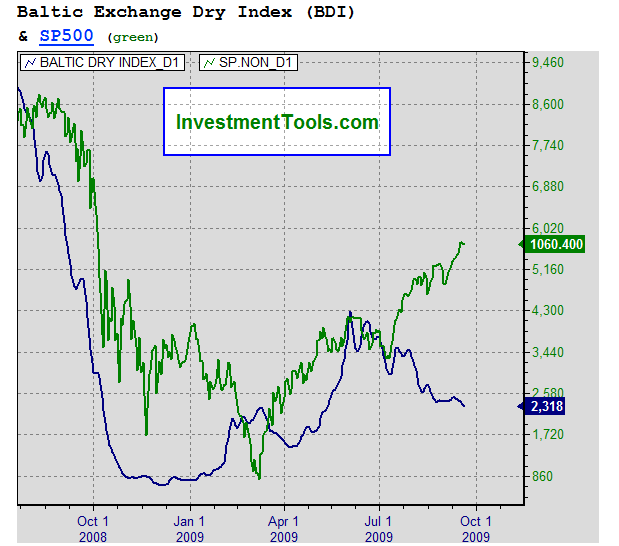
BDvsS&P500

In recent weeks the BDI has staged a substantial correction, leading many confounded as to why things are so. Many believed that the global recovery has started, and that things will still take some time before it gets anywhere to business as usual - even so, the sharp correction in the BDI has some worried. More significantly, those stock markets riding on China leading them out of a recession, may be sitting nervously now - if the mega China stimulus plan is supposed to do what it does, China should be doing a lot of importing, thus the BDI should be well supported, not declining.

The chart above is very telling. Many mid-term traders uses the BDI as a major indicator of whether to hold a lot of positions in the stock market or to pare down their holdings. The correlation with the S&P500 has been uncanny but the thing started to diverge since July 2009. That caused a lot of experts to call for a temporary sell on the equity side, and have been kept getting things wrong. When such a divergence happens, and when you plot one variable against the stock market index... 9 out of 10 times, the experts will say that the stock market index is WRONG and the other variable is right. This blatant discrimination lies in the fact that all experts think that the stock markets are generally made up of idiots, momentum traders, retail players who will buy and sell at the wrong time. The same group of experts will accord "more respect" to BDI because its a more localised index and is research and accumulated from real industry players.

So, who is right? Has the stock markets run ahead of themselves? Even if you look at commodity prices in general, they have held up pretty well over the last 2 months, which is even more confounding - if commodity prices are steady with a slight upside bias, why then was the BDI so weak.

This time around, I am siding with the stock index, I think it is more correct than the BDI. The BDI is a highly volatile indicator, and if you look at it, the BDI has risen enormously for the first half of the year. A correction is normal as many industry operators are loathed to bet on a strong recovery in global trade, they'd rather sell their open capacity as and when possible. The divergence is significant because the BDI has fallen more than 40% since June 09, while the S&P500 has gone the other way.

Traders and experts harping on the sanctity and importance of BDI need to go wash their faces every now and then. Just because the BDI was a good indicator does not mean it will always be a good leading indicator for the stock market. Things evolve. The BDI this time around was very much affected by things happening in China, when they announce the stimulus plan, the BDI went ballistic. When China construction slowed over the last 2 months, the BDI started to collapse. The key is understanding what, where and why China is doing what it is showing. You cannot comment on the BDI superficially until you understand the motivations behind those figures.

The highest level the BDI reached this year was 4,291 points on June 3. The index as of yesterday was just 2,357. The BDI may hit 4,000 points before the year is over just be assessing the increasing demand for iron ore and grains from China. Iron ore demand is linked to construction activity, which many international traders saw as weakening over the last 3 months. One has to understand the nature of construction in China. Most construction works were slow in the third quarter owing to hot weather, which is quite common especially in southern China. The recent cold spell should prompt more coal to be exported to China as well. Iron ore is the largest dry-bulk cargo moved by sea and China is a major consumer of the commodity.

Furthermore bumper crop harvesting such as wheat and corn in the United States would also contribute to the rise in the BDI in the coming weeks. Bloomberg reported China Ocean Shipping (Group) Co as saying the BDI might surge more than 80% by the year-end on increased demand from China.

Aside from the China demand factor, the shipping industry is facing a crucial issue and that is the potential supply of new ships. It is a complicated issue because older ships to transport coal, iron ore, fertilizer and the like are being retired while new ones are coming to take their place. There seems to be more supply than needed coming online over the next 6 months and that's also scaring the BDI lower.

The stimulus plan by China has barely started to kick in but the BDI has staged a magnificent rally since February this year, safe to say here that the BDI has run a bit ahead of the real economy. China has started to turn the taps from its stimulus plan but certainly not all will done in one shot or over just one year, in that sense the BDI may have no reason to join in the rally in the first place with the S&P500, and now is just correcting to the real economy, and not the other way around.


p/s photos: Angelababy Yang Wing


Central Banks & Their Gold Strategy


We all know that the biggest demand for gold comes from central banks. Just how has their buying or selling strategy been over the last 12 months? Is their strategy influenced by the amount of USD being printed into circulation? Are they afraid of the dollar not being able to uphold its long term value? Will they ever regard holding US Treasuries as an option only? Is any of them seriously hinting of reverting back to the gold standard? By holding more gold and less USD does that mean more flexibility to their monetary policy?

  • Reduced central bank gold selling and increased investor buying may have been helping to underpin high prices in 2008 at a time of turmoil in financial markets. The renewal of the central bank gold selling agreement with a lower threshold suggests that gold sales by central banks will be lower in the next five years, a move the could support gold prices.
  • Gold's share in global foreign exchange reserves is about 10%, the third largest asset by value despite being unevenly distributed across countries. The U.S. and European central banks account for the highest amounts both in absolute terms and as a share of reserve holdings (about 50%). Emerging market central banks have a much smaller share. Gold's share in global reserves declined sharply since the 1950s -1960s.
  • Regulation of Central Bank gold sales

  • In August 2009, the central banks party to the central bank gold agreement (CBGA), who collectively have a gold share of just under 60% in their reserves, agreed to renew the treaty but with a lower maximum sales threshold. Analysts suggest that the marginally lower threshold could provide a "mild support" for gold.
  • The annual sales by the central banks party to the treaty will be less than 400 tons. The previous agreement had a cap of 500 tons per years. The IMF's planned sales of 403 tons are included in the overall cap of 2000 tons from 2009-2014. With the Swiss National bank suggesting it will not sell, only the European central bank and the Banque de France are likely to take advantage to sell. The Italian and German central banks have been reluctant to sell their gold holdings.
  • In H1 2009, estimated net sales by official holders of gold were 39 tonnes, 73% lower than in H1 2008. Net gold official gold sales are expected to be only 140 tons in 2009, the lowest since 1994.
  • In 2008, European central banks sold the lowest levels of gold in about decade, reversing the practice of recent years whereby official sales helped depress gold prices. Banks bound by the central bank gold agreement (most of the European central banks) sold about 343 tons of gold , the lowest since the first agreement was signed in 1999, and well under the 500 ton annual limit.
  • In the fall of 2008, central banks stopped lending out gold to banks as they were afraid they would not get it back. This reluctance contributed to an increase in bullion borrowing costs to 2.649% for one month, the highest since May 2001 and high above recent levels (5yr average 0.12%).
  • An asset allocation assessment would suggest European central banks still have too much gold. EM central banks have low gold holdings in part because of the rising cost of gold and worries about an inability to sell when forex liquidity is required.
  • Gold holdings of Emerging Market Central banks

  • GCC private investors have much higher stocks of gold than its central banks do. However, Qatar increased its gold reserves in 2007.
  • China announced early in 2009, that it had increased its total gold holdings by 75%, likely from shifting non-monetary gold to the central bank. Although that increase now makes China one of the top 5 official gold holders, gold makes up less than 2% of China's $2.1 trillion in foreign exchange reserve by value. On the margins, China is likely to keep adding slowly to its holding but it is unlikely to make purchases on the open market given the potential for disrupting prices and reducing the value of USD holdings
  • Aside from China with 1054 tons, the emerging market central banks with the largest gold holdings are Russia (540 tons), Taiwan (424 tons), India (358 tons) and Venezuela (356 tons) as of May 2009. Aside from Venezuela and Lebanon, the gold shares of which make up 37.5% and 27.5% respectively of total reserves, most of the other large holders have a gold share of only about 4% of reserves.

Gold Sales by the IMF

  • The IMF, the third-largest official holder of gold, intends to sell 403 tons (12%) of its 3217 tons of gold, pending approval from 85% of its members which will likely be given in the fall. Any sales are likely be gradual though and may be sold to central banks.
  • IMF gold sales are unlikely to be disruptive for the gold market and could be positive if the gold is purchased by other official investors (like central banks).
  • The IMF is likely to start selling in 2010, selling about 200 tons a year.


p/s photos: Aya Nakata

Asia Rising - Part Three


"Dictatorship Has Given Asia an Advantage."

No. Autocracies, mainly in East Asia, may seem to have made their countries prosperous. The so-called dragon economies of South Korea, Taiwan, Singapore, Indonesia under Suharto, and now China experienced their fastest growth under nondemocratic regimes. Frequent comparisons between China and India appear to support the view that a one-party state unencumbered by messy competitive politics can deliver economic goods better than a multiparty system tied down by too much democracy.

But Asia also has had many autocracies that have impoverished their countries-consider the tragic list of Burma, Pakistan, North Korea, Laos, Cambodia under the murderous Khmer Rouge, and the Philippines under Ferdinand Marcos. Even China is a mixed example. Before the Middle Kingdom emerged from self-imposed isolation and totalitarian rule in 1976, its economic growth was subpar. China under Mao also had the dubious distinction of producing the world's worst famine.

Even when you look at autocracies credited with economic success, you find two interesting facts. First, their economic performance improved when they became less brutal and allowed greater personal and economic freedoms. Second, the keys to their successes were sensible economic policies, such as conservative macroeconomic management, infrastructural investment, promotion of savings, and pushing exports. Dictatorship really has no magic formula for economic development.

Comparing a one-party state like China with a democracy such as India is not an easy intellectual exercise. Obviously, India has many weaknesses: widespread poverty, poor infrastructure, and minimal social services. China appears to have done much better in these areas. But appearances can be deceiving. Dictatorships are good at concealing the problems they create while democracy is good at advertising its defects.

So the autocratic advantage in Asia is, at best, an optical illusion.


"China Will Dominate Asia."

Not likely. China is on course to overtake Japan as the world's second-largest economy this year. As the regional economic hub, China is now driving Asia's economic integration. Beijing's diplomatic influence is expanding as well, supposedly thanks to its newfound soft power. Even China's once antiquated military has acquired a full plethora of new weapons systems and significantly improved its ability to project force.

Although it is true that China will become Asia's strongest country by any measure, its rise has inherent limits. China is unlikely to dominate Asia in the sense that it replaces the United States as the region's peacekeeper and decisively influences other countries' foreign policies. Its economic growth is also by no means guaranteed. Restive secession-minded minorities (Tibetans and Uighurs) inhabit strategically important areas that constitute almost 30 percent of Chinese territory. Taiwan, which is unlikely to return to China's fold anytime soon, ties down substantial Chinese military resources. The ruling Chinese Communist Party, which views perpetuating its one-party state as more important than overseas expansionism, is not likely to be seduced by delusions of imperial grandeur.

China has formidable neighbors in Russia, India, and Japan that will fiercely resist any Chinese attempts to become the regional hegemon. Even Southeast Asia, where China appears to have reaped the most geopolitical gains in recent years, has been reluctant to fall into China's orbit completely. Nor would the United States simply capitulate in the face of a Chinese juggernaut.

For complex reasons, China's rise has inspired fear and unease, not enthusiasm, among Asians. Only 10 percent of Japanese, 21 percent of South Koreans, and 27 percent of Indonesians surveyed by the Chicago Council on Global Affairs said they would be comfortable with China being the future leader of Asia.

So much for China's charm offensive.


p/s photos: Michelle Yip Shuen


Asia Rising - Part Two


"Asian Capitalism Is More Dynamic."


Hardly. With the United States brought low by Wall Street and the European economy enfeebled by its welfare state and inflexible labor market, most Asian economies appear in great shape. It is tempting to say that Asia's unique brand of capitalism, by seamlessly weaving together strategic state intervention, corporate long-term thinking, and insuppressible popular desire for material betterment, will outcompete either the greed-devastated U.S. model or the hidebound European variant.

But though Asian economies-with the notable exception of Japan-are among the fastest-growing in the world today, there's little real evidence to suggest that their apparent dynamism comes from a mysteriously successful form of Asian capitalism. The truth is more mundane: The region's dynamism owes a great deal to its strong fundamentals (high savings, urbanization, and demographics) and the benefits of free trade, market reforms, and economic integration. Asia's relative backwardness is a blessing in one sense: Asian countries have to grow faster because they're starting from a much lower base.

Asian capitalism does have three unique features, but they do not necessarily confer competitive advantages. First, Asian states intervene more in the economy through industrial policy, infrastructural investment, and export promotion. But whether that has made Asian capitalism more dynamic remains an unresolved puzzle. The World Bank's classic 1993 study of the region, "The East Asian Miracle," could not find evidence that strategic intervention by the state is responsible for East Asia's success. Second, two types of companies-family-controlled conglomerates and giant, state-owned enterprises-dominate Asia's business landscape. Although such corporate ownership structures enable Asia's largest companies to avoid the short-termism of most American firms, they also shield them from shareholders and market pressures, making Asian firms less accountable, less transparent, and less innovative.

Finally, Asia's high savings rates, by providing a huge pool of indigenous capital, undeniably fuel the region's economic growth. But pity Asia's savers. Most of them save because their governments provide inadequate social safety nets. Government policies in Asia penalize savers through financial repression (by keeping deposit rates low and paying household savers measly returns on their savings) and reward producers by subsidizing capital (typically through low bank lending rates). Even export promotion, ostensibly an Asian virtue, seems overrated. Asian central banks have invested most of their massive export surpluses in low-yielding, dollar-dominated assets that will lose much of their value due to the long-term inflationary pressures generated by U.S. fiscal and monetary policies.


"Asia Will Lead the World in Innovation."

Not in our lifetime. If you look only at the growing number of U.S. patents awarded to Asian inventors, the United States appears to have a dramatically receding edge in innovation. South Korean inventors, for example, received 8,731 U.S. patents in 2008-compared with 13 in 1978. In 2008, close to 37,000 U.S. patents went to Japanese inventors. The trend seems sufficiently alarming that one study ranked the United States eighth in terms of innovation, behind Singapore, South Korea, and Switzerland.

Reports of the death of America's technological leadership are, to paraphrase Mark Twain, greatly exaggerated. Although Asia's advanced economies, such as Japan and South Korea, are closing the gap, the United States' lead remains huge. In 2008, American inventors were awarded 92,000 U.S. patents, twice the combined total given to South Korean and Japanese inventors. Asia's two giants, China and India, still lag far behind

Asia is pouring money into higher education. But Asian universities will not become the world's leading centers of learning and research anytime soon. None of the world's top 10 universities is located in Asia, and only the University of Tokyo ranks among the world's top 20. In the last 30 years, only eight Asians, seven of them Japanese, have won a Nobel Prize in the sciences. The region's hierarchical culture, centralized bureaucracy, weak private universities, and emphasis on rote learning and test-taking will continue to hobble its efforts to clone the United States' finest research institutions.

Even Asia's much-touted numerical advantage is less than it seems. China supposedly graduates 600,000 engineering majors each year, India another 350,000. The United States trails with only 70,000 engineering graduates annually. Although these numbers suggest an Asian edge in generating brainpower, they are thoroughly misleading. Half of China's engineering graduates and two thirds of India's have associate degrees. Once quality is factored in, Asia's lead disappears altogether. A much-cited 2005 McKinsey Global Institute study reports that human resource managers in multinational companies consider only 10 percent of Chinese engineers and 25 percent of Indian engineers as even "employable," compared with 81 percent of American engineers.


p/s photos: Nancy Wu Ding Yan


Asia Rising - Part One


The esteemed Foreign Policy magazine has been putting out great perspectives on the rise of Asia, both as an economic power and militarily, albeit the latter is much more fragmented. The first part looks at the realistic predictions of China or India as economic powers in their own right. While growth rates and population strength have been often cited, its still a long way off.

Asia is nowhere near closing its economic and military gap with the West. The region produces roughly 30 percent of global economic output, but because of its huge population, its per capita gdp is only $5,800, compared with $48,000 in the United States. Asian countries are furiously upgrading their militaries, but their combined military spending in 2008 was still only a third that of the United States. Even at current torrid rates of growth, it will take the average Asian 77 years to reach the income of the average American. The Chinese need 47 years. For Indians, the figure is 123 years. And Asia's combined military budget won't equal that of the United States for 72 years.

In any case, it is meaningless to talk about Asia as a single entity of power, now or in the future. Far more likely is that the fast ascent of one regional player will be greeted with alarm by its closest neighbors. Asian history is replete with examples of competition for power and even military conflict among its big players. China and Japan have fought repeatedly over Korea; the Soviet Union teamed up with India and Vietnam to check China, while China supported Pakistan to counterbalance India. Already, China's recent rise has pushed Japan and India closer together. If Asia is becoming the world's center of geopolitical gravity, it's a murky middle indeed.

Those who think Asia's gains in hard power will inevitably lead to its geopolitical dominance might also want to look at another crucial ingredient of clout: ideas. Pax Americana was made possible not only by the overwhelming economic and military might of the United States but also by a set of visionary ideas: free trade, Wilsonian liberalism, and multilateral institutions. Although Asia today may have the world's most dynamic economies, it does not seem to play an equally inspiring role as a thought leader. The big idea animating Asians now is empowerment; Asians rightly feel proud that they are making a new industrial revolution. But self-confidence is not an ideology, and the much-touted Asian model of development does not seem to be an exportable product.


"Asia's Rise Is Unstoppable."

Don't bet on it. Asia's recent track record might seem to guarantee its economic superpower status. Goldman Sachs, for instance, expects that China will surpass the United States in economic output in 2027 and India will catch up by 2050.

Given Asia's relatively low per capita income, its growth rate will indeed outpace the West's for the foreseeable future. But the region faces enormous demographic hurdles in the decades ahead. More than 20 percent of Asians will be elderly by 2050. Aging is a principal cause of Japan's stagnation. China's elderly population will soar in the middle of the next decade. Its savings rate will fall while healthcare and pension costs explode. India is a lone exception to these trends-any one of which could help stall the region's growth.

Environmental and natural resource constraints could also prove crippling. Pollution is worsening Asia's shortage of fresh water while air pollution exacts a terrible toll on health (it kills almost 400,000 people each year in China alone). Without revolutionary advances in alternative energy, Asia could face a severe energy crunch. Climate change could devastate the region's agriculture.

The current economic crisis, moreover, will lead to huge overcapacity as Western demand evaporates. Asian companies, facing anemic consumer demand at home, will not be able to sell their products in the region. The Asian export-dependent model of development will either disappear or cease to be a viable engine of growth.

Political instability could also throw Asia's economic locomotive off course. State collapse in Pakistan or a military conflict on the Korean Peninsula could wreak havoc. Rising inequality and endemic corruption in China could fuel social unrest and cause its economic growth to sputter. And if a democratic breakthrough somehow forces the Communist Party from power, China is most likely to enter a lengthy period of unstable transition, with a weak central government and mediocre economic performance.


p/s photos: Yuna Ito

China Close To "Disowning" North Korea


The one over-riding cloud hanging over the markets is North Korea's belligerence and stupidity. Even if you have Obama or the United Nations voicing concerns and admonishments. The dog will only listen to its master, and by master we all know its China. China has finally lost its cool with North Korea, it has suspended all government exchanges with North Korea - now Kim knows that he has pissed off everybody royally, even his only friend. North Korea still have Russia, but Russia is nowhere as important as China. North Korea's relationship with China is highly critical to North Korea. North Korea is like a bully who has a very mighty big brother tacitly "supporting" North Korea even when the rest of the world places an embargo or sanctions. Now that is gone - which is to say, North Korea will have to toe the line or face the consequences as China is close to disowning this bastard of a nation (I should really say its the leader who is at fault, and not the people of North Korea). Its another cloud being lifted from the bull runs around world exchanges.

--------------------------------------

June 1 (Bloomberg) -- China suspended government exchanges with North Korea after Kim Jong Il's regime last week tested a nuclear device and fired short-range missiles, Yonhap News said.

China has halted plans to send officials to North Korea and won’t accept visits from there either, Yonhap said today, citing unidentified diplomatic sources in Beijing. China’s foreign ministry didn’t respond to a faxed request for comment. South Korean government spokesman Lim Jung Taek said he couldn’t confirm or deny the report.

The move, if confirmed, would be the strongest reaction yet to North Korea’s actions by its biggest ally and trading partner. China accounts for almost three-fourths of North Korea’s foreign trade, and can cut off shipments to the impoverished country of food, fuel and luxury goods.

China has said it “resolutely opposes” North Korea’s nuclear test, and agreed last week with the U.S., Japan and Russia to work toward a United Nations Security Council resolution censuring the regime. U.S. Defense Secretary Robert Gates, who is in Asia for a week-long tour, said on May 29 that “based on what the Chinese government has said publicly, they’re clearly pretty unhappy.”

Dependence on China

China accounted for 73 percent of North Korea’s global trade last year, up from less than a third in 2003, according to the Seoul-based Korea Trade & Investment Promotion Agency. It supplies 90 percent of North Korea’s oil, 80 percent of consumer goods and 45 percent of its food, according to Dong Yong Seung, a researcher on North Korean issues at the Samsung Economic Research Institute in Seoul.

North Korea’s economic output was about $26 billion in 2007, according to the World Bank, less than 3 percent of South Korea’s $970 billion economy.

South Korea responded to the atomic explosion by joining a U.S.-led initiative to halt shipments of weapons of mass destruction. The North then warned that any move to seize its ships would be met with military retaliation, and also fired six short-range missiles in a show of defiance.

Gates said May 30 that the communist regime would be held “fully accountable” for the consequences of transferring nuclear weapons or material to “states or non-state entities.”

‘Never Tolerate’

“The Republic of Korea will never tolerate North Korea undertaking military threats and provocation and ignoring the way to peace and dialogue,” South Korean President Lee Myung Ba said in a bi-weekly radio speech today.

North Korea’s military ordered ships in the Yellow Sea and units guarding the country’s coast to double their ammunition stockpiles, Yonhap News reported today, citing a South Korean government official it didn’t identify. The North is also planning to launch a long-distance ballistic missile as early as this month, Yonhap said over the weekend.

The U.S. and Japan are seeking a UN Security Council resolution that cuts North Korea’s international financial ties as well as China’s help in persuading it to abandon its nuclear ambitions.


p/s photo: Maki Nishiyama
Copyright © Long Term Payday Loans. All Rights Reserved.
Blogger Template designed by Click Bank Engine.